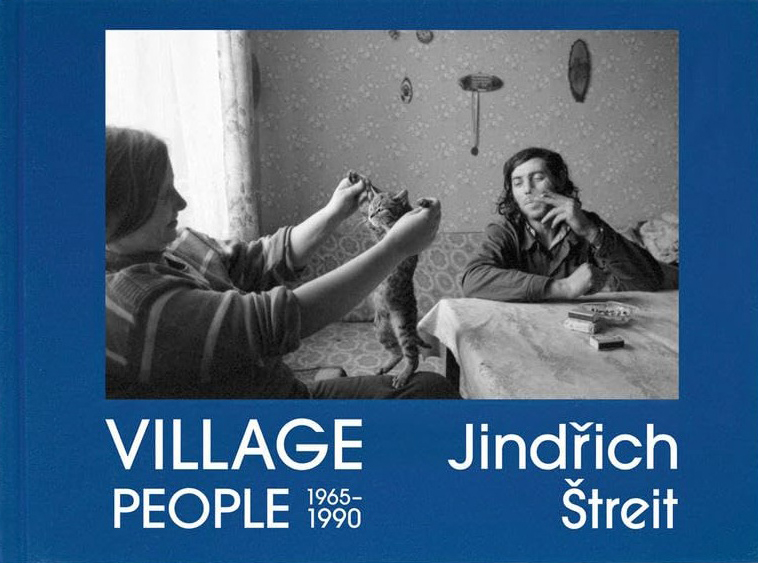
Village People 1965–1990
- Publisher
- Buchkunst Berlin
- Year
- 2020
- ISBN
- 978-3-9819805-6-1
- Specifications
- Hardcover, linen binding
22,5 x 30,5 cm
137 black and white plates
Triton printing
German, English and French
Text by Vladimír Birgus
Edited by Thomas Gust and Ana Druga
Picture selection: Thomas Gust, Ana Druga and Vladimír Birgus
Scan: Thomas Gust
Retouching and litho: Ana Druga
Printing and binding: Wanderer Druckerei, Germany
First edition, December 2020
Deutscher Fotobuchpreis 2021/22, Bronze
"Jindřich Štreit's poetic and radical photographs created a universal image of humanity. Today they are among the great classics of humanistic photography."
is an extraordinary chronicler and storyteller. Over five decades he describes life in the countryside in the Czech regions of North Moravia and Bohemia in his black and white photographs. It is a comprehensive photographic and sociological study, similar in scope and artistic quality to that of August Sander in Germany or Eugene Atget in Paris. In its own style and visual language, just grown in secret, at the very end of the world at that time. In reality, Sovinec is pretty much in the middle of Europe. This region is shaped by the confusion and damage of the world wars and a subsequent dictatorship, whose rituals and imagery in the everyday world of that time often appear absurd to us as viewers today. Jindřich Štreit describes the isolation and isolation of people in everyday life in the socialist school tives. But in private, as well as at communal celebrations and meetings, the photographs show the joy of life, a strong community and solidarity. This becomes even clearer when compared with the recordings of the state's official rallies and celebrations. The contrast between the content of the dispute and the official ideological representations could not be more serious. Criticism of the existing living conditions was always present in the images and could not be understood as anything other than criticism by a totalitarian state with its rigid vocabulary and sign language. From the 1980s onwards, this led to a ban on publication in any form, arrests and constant controls by the state. Despite constantly taking photographs, he remained unknown in the history of photography until the end of socialism. Since the 90s, na After his rehabilitation, his pictures were shown worldwide and are represented in the most important photographic collections. In his home country he is one of the most famous photographers, as well as a valued teacher at the leading universities in the Czech Republic.
“Jindrich Streit’s poetic, radical photos have captured a universal image of mankind.
Today they belong among the great classics of humanistic photography.”