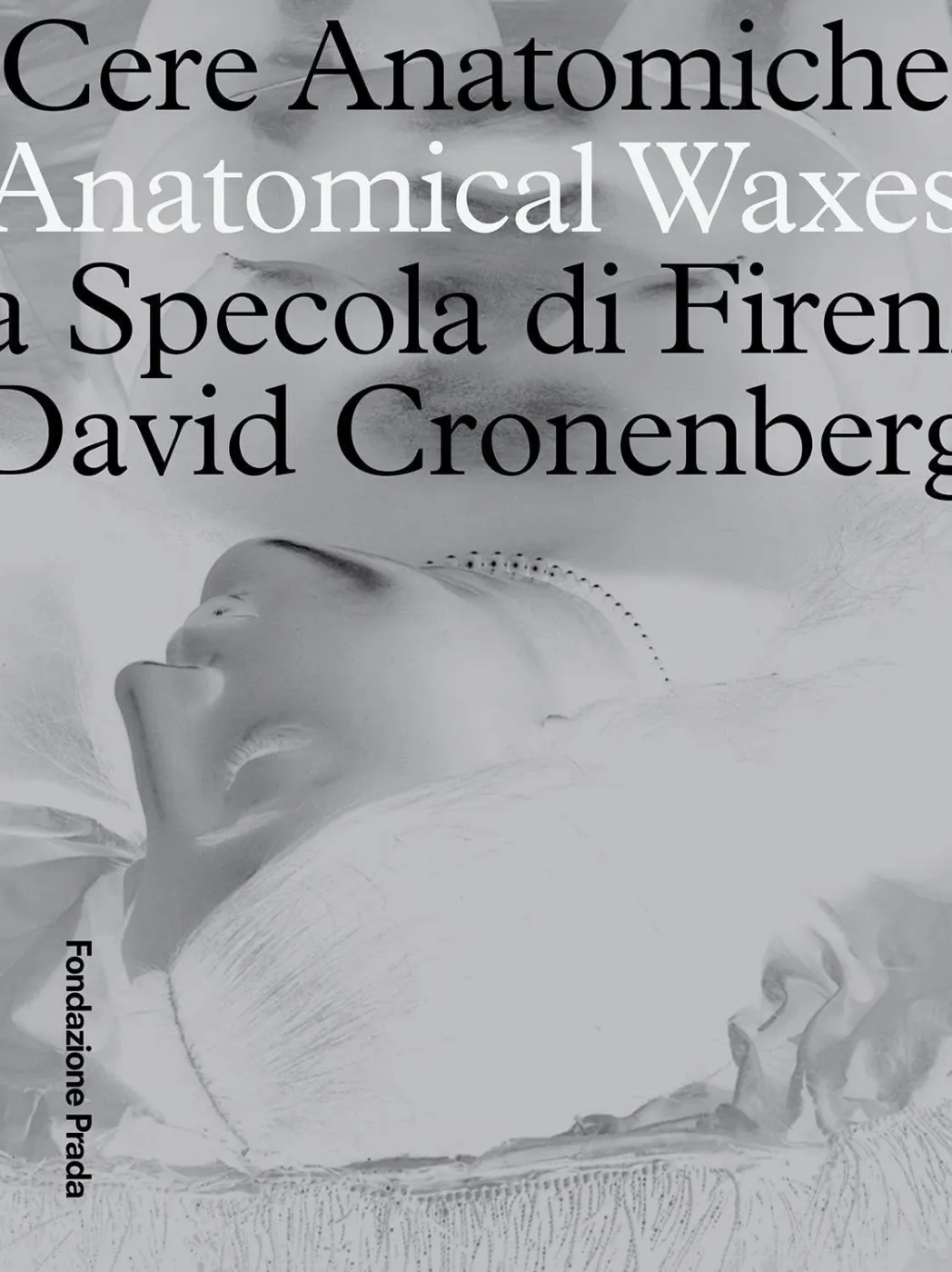
Cere Anatomiche - La Specola di Firenze | David Cronenberg
- Publisher
- Fondazione Prada
- Year
- 2023
- ISBN
- 9788887029840
- Specifications
- Softcover
17 x 22.7 cm
556 pages
195 ill.
English with Italian translations
Editor: Mario Mainetti
Introductions by Miuccia Prada, Marco Benvenuti
Declaration by David Cronenberg
Conversations between Claudia Corti and Mario Mainetti, and between Eva Sangiorgi and David Cronenberg
Texts by Roberta Ballestriero, Paul Brown, Riccardo Venturi, Sandra Zecchi
Anthology of texts by Maria Luisa Azzaroli, Fausto Barbagli, Mario Bucci, Gianni Canova, Simone Contardi, Eleanor Crook, Francesco Paolo de Ceglia, Georges Didi-Huberman, Joanna Ebenstein, Giovanni Festa, Marcie Frank, Mauro Giori, John Hatch, Zoltan Kádár, Peter K. Knoefel, Chloe Anna Milligan, Marta Poggesi, Mario Praz, Dylan Trigg and Marcos Uzal
Graphic design: Irma Boom, Anna Moschioni
“Cere anatomiche” (Anatomical Waxes) is an exhibition conceived with La Specola, part of the Museum of Natural History of the University of Florence, and film director David Cronenberg. La Specola, created in 1775 and one of the oldest science museums in Europe, holds the world’s most extensive collection of eighteenth-century anatomical waxes and the collection of Sicilian wax modeller Gaetano Giulio Zumbo: 1,400 pieces made between the late eighteenth and early nineteenth century to illustrate the anatomy of the human body without recourse to the direct observation of a corpse. The project unfolds in two parts: an exhibition of thirteen eighteenth-century ceroplastic works, including four reclining female figures such as the so-called Venus, a rare model with detachable parts; and a series of seventy-two exhibition copies of anatomical drawings. A short film by David Cronenberg, titled Four Unloved Women, Adrift on a Purposeless Sea, Experience the Ecstasy of Dissection, realised in the spaces of La Specola, offers an alternative gaze on the four female wax models, exploring the fascination with the human body and its mutations. As Cronenberg explains, the wax figures “happened to produce living characters who seemed to be in the throes of ecstasy”, a startling choice by their sculptors that captured his imagination: “what if it was the dissection itself that induced that ecstasy, that almost religious rapture?”