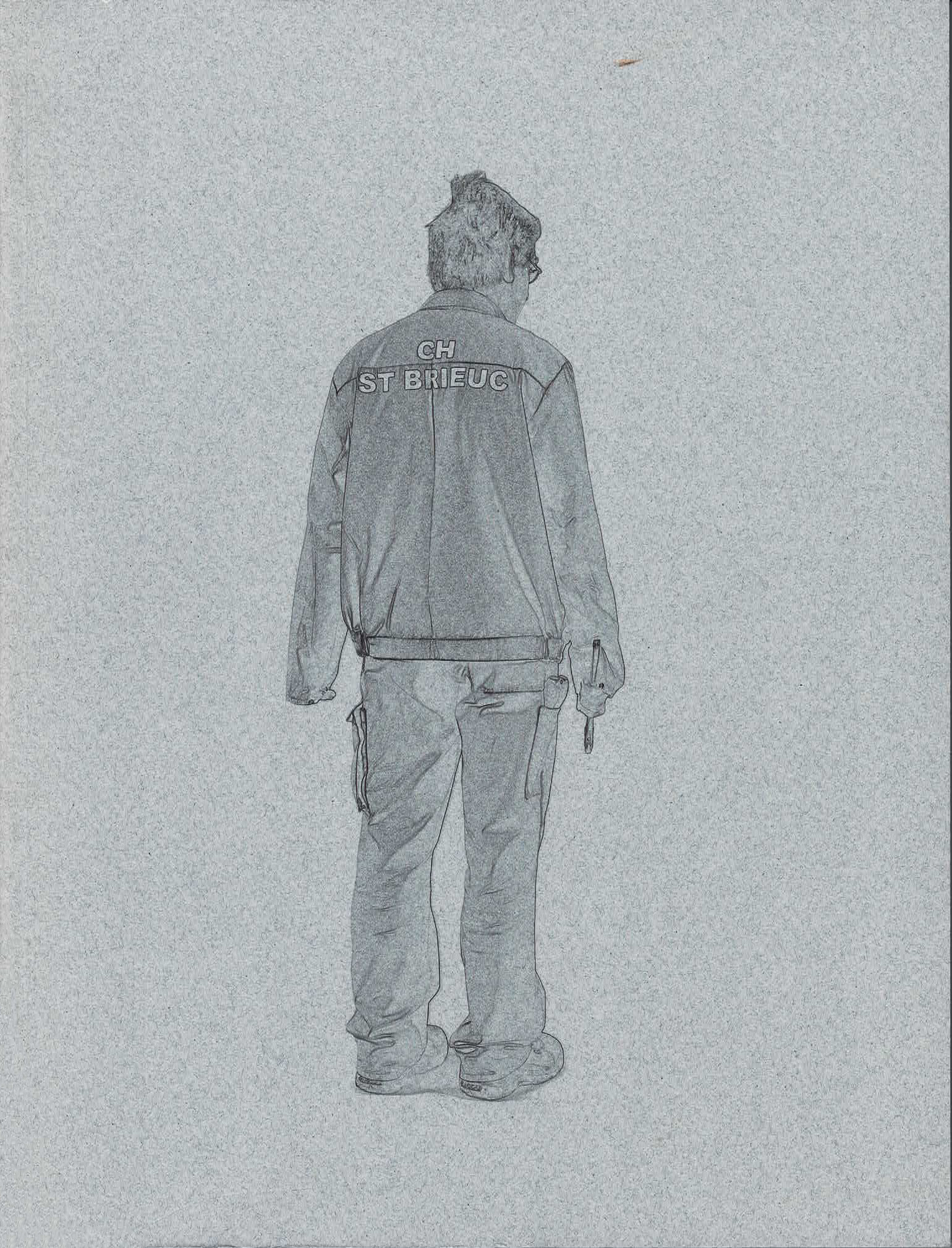
Corps hospitalier
- Publisher
- GwinZegal
- Year
- 2009
- ISBN
- 9782952809986
- Specifications
- 29 × 26 cm
224 pages
Olivier Metzger photographed all the professions at the Yves Le Foll Hospital Center in Saint-Brieuc in 2008. The aim here was not to photograph all the people working at the Hospital Center, but rather, for each of the functions identified, to create a portrait of a professional so that he or she then represents, in some way, the archetype of this profession. This work made it possible to make “visible” the complexity and diversity of functions at work in a hospital and the central role of man. In a studio set up in the very heart of the hospital, the “models” are photographed in work clothes, sometimes with an element representative of the function performed. Each model finds itself outside the environment of its professional practice in a neutral setting. The reason for this choice is twofold. First of all, it gives all the portraits a coherence capable of defining the working community. Second, it does not “hierarchize” and thus makes the interdependence of all the functions of the Hospital perceptible. It is also, beyond the interest in the human dimension of these professions, the desire to create a “freeze frame” of the professional history of the institution, to “date” the professions and technologies implemented in 2008 in the treatment of health problems. The great quality and subtlety of Olivier Metzger's work lies in his way of capturing as closely as possible the singularity of the person photographed while visually “integrating” them into the larger community of people working at the hospital. As a counterpoint, Olivier Metzger created “portraits” of machines, these “technological assistants” which today occupy an increasingly important and visible place. By giving them a photographic status in their own right, it highlights, beyond the sculptural dimension of these tools, the evolution of the man/machine relationship and its implications for the hospital. Finally, the photographer wanted to restore through portraits of patients the primary purpose of the institution, to treat men and women. Added to this are the portraits of all those, florist, chaplain, imam, volunteer visitor, who without being directly attached to the Hospital, participate in the well-being of the whole.